Beneath the Forest Floor: How America's Mushroom Foragers and Small-Scale Cultivators Are Redefining Umami in the Discerning Kitchen
There is a particular kind of patience required to work with mushrooms. It is not the patience of the baker, who watches dough rise in a warm kitchen, nor the patience of the cheesemaker, who monitors temperature with disciplined regularity. The patience demanded by fungi is older and more mysterious — it belongs to the forest, to the fog, to the slow decomposition of fallen timber. It is, in many ways, the patience of abundance itself.
Across the Pacific Northwest, the Appalachian highlands, the Upper Midwest, and the cultivated grow rooms of small-scale producers throughout the country, a generation of American foragers and mushroom farmers is bringing that patience to bear on one of the most complex flavor compounds in the culinary world: umami. The fifth taste — savory, lingering, and deeply satisfying — finds one of its most concentrated and nuanced expressions in fungi, and those who understand this are quietly reshaping what belongs in a thoughtful cook's pantry.
Understanding the Fifth Taste Through the Lens of Fungi
Umami, a term borrowed from the Japanese words for "delicious" and "taste," was formally identified as a distinct flavor category in the early twentieth century by chemist Kikunae Ikeda. He traced its origin to glutamates — naturally occurring amino acids that stimulate specific receptors on the palate and produce that characteristic sensation of depth and satisfaction. Mushrooms, particularly dried or aged specimens, are among the most glutamate-rich foods found in nature.
What makes mushrooms singular, however, is not simply the presence of glutamates but the way those compounds interact with guanylates — nucleotides that amplify the umami effect synergistically. When a dried porcini is simmered into a broth or a handful of dried shiitake is rehydrated and folded into a braise, the result is not merely additional flavor. It is a multiplication of flavor — a phenomenon that food scientists refer to as umami synergy. For the discerning home cook, this is not trivia. It is a practical key to building extraordinary depth from modest means.
Wild Foraged: The Irreplaceable Vocabulary of the Forest
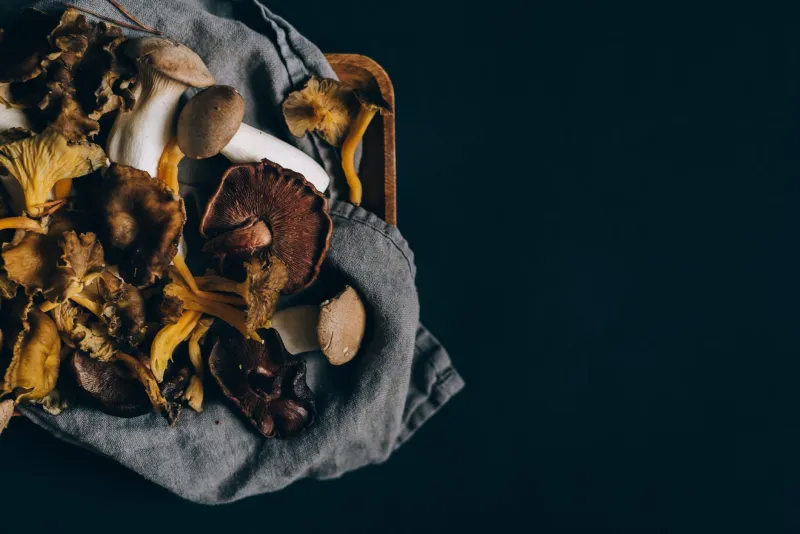
No cultivation program, however sophisticated, fully replicates what the forest produces. Wild-foraged mushrooms carry what some foragers describe as "ecological memory" — a flavor profile shaped by the specific trees, soils, rainfall patterns, and microclimates of their habitat. The morel, perhaps the most celebrated of North American wild mushrooms, emerges in spring across a vast swath of the country, from the Ozarks to the Cascades, its flavor a smoky, nutty, almost meaty complexity that bears little resemblance to anything cultivated.
Matsutake, prized in Japanese cuisine and increasingly recognized by American chefs, grows in the pine forests of the Pacific Northwest and Northern California, where it forms symbiotic relationships with specific tree species that cannot be replicated artificially. Its aroma — spicy, resinous, deeply aromatic — is unlike any other fungus, and its rarity drives both its price and its mystique.
Small-scale foraging operations, often family-run or cooperatively organized, are doing critical work in bringing these varieties to market with both ecological responsibility and culinary integrity. Foragers such as those working through regional mushroom co-ops in Oregon and the Carolinas operate under strict harvesting protocols — taking only mature specimens, leaving root structures intact, rotating harvest areas — ensuring that the forest floor continues to yield for seasons to come.
For the home cook, sourcing from these small operations, whether through farmers markets, regional specialty food retailers, or community-supported agriculture arrangements, is the most direct path to wild mushrooms of genuine provenance and exceptional quality.
Intentional Cultivation: The Art and Science of the Grow Room
If wild foraging is an act of listening to the forest, cultivation is a conversation with it. America's small-scale mushroom cultivators have developed sophisticated grow environments that honor the biological requirements of specific varieties while making them accessible beyond their brief seasonal windows.
Lion's mane, with its cascading white tendrils and a flavor that many describe as reminiscent of crab or lobster, has become a flagship variety for small-batch cultivators from Vermont to California. Oyster mushrooms — golden, blue, and pink varieties among them — offer a delicate, almost briny quality that responds beautifully to high-heat cooking. Maitake, known colloquially as hen-of-the-woods, presents a layered earthiness that deepens dramatically when roasted or dehydrated.
Producers such as small urban farms and rural specialty operations are cultivating these varieties on substrates ranging from oak logs to spent coffee grounds, each medium imparting subtle distinctions to the finished product. The best among these cultivators approach their work with the same rigor as an artisan cheesemaker or a craft brewer — tracking humidity, airflow, and inoculation timing with meticulous care.
What distinguishes the finest cultivated mushrooms from commodity varieties is not simply freshness but intentionality. When a small-scale cultivator selects a specific strain of shiitake for its elevated glutamate content or a particular oyster variety for its texture under heat, they are making decisions that translate directly into flavor outcomes for the cook.
Selecting, Storing, and Preserving for Pantry Depth
For the discerning home cook, mushrooms need not be a strictly seasonal indulgence. With thoughtful selection and proper preservation, they can become a year-round pillar of pantry depth.
Fresh mushrooms should be chosen for firmness, dry surfaces, and a clean, earthy aroma — any sign of sliminess or sour smell indicates age or improper handling. Store them loosely in a paper bag in the refrigerator, never sealed in plastic, which traps moisture and accelerates deterioration.
Drying, however, is where mushrooms reveal their greatest pantry potential. The dehydration process concentrates glutamates dramatically, transforming a pound of fresh porcini into a few ounces of intensely flavored dried slices that will keep, properly sealed, for a year or more. Dried mushrooms can be ground into powders — a technique increasingly embraced by thoughtful home cooks — and used as a dry rub component, a seasoning for pasta dough, or a silent depth-builder stirred into pan sauces.
The soaking liquid from rehydrated dried mushrooms is itself a pantry treasure: strained carefully through a fine-mesh sieve or coffee filter to remove grit, it becomes a concentrated umami broth that elevates everything from risotto to vinaigrettes. Discard it at your peril.
For those with access to a dehydrator or even a low-temperature oven, home drying of fresh mushrooms sourced from local foragers or cultivators is among the most rewarding acts of pantry stewardship available to the American home cook.
The Larger Abundance
The work of America's mushroom foragers and small-scale cultivators is, at its heart, an act of restoration — not merely of flavor, but of relationship. A relationship between the kitchen and the forest, between the cook and the land, between the immediate and the preserved. In sourcing these ingredients with care and learning to use them with understanding, the discerning cook participates in a tradition far older than any recipe.
The cornucopia, that ancient symbol of abundance, has always contained more than fruit and grain. It holds, too, the quiet gifts of the forest floor — the morel emerging from spring soil, the maitake clustered at the base of an oak, the lion's mane unfurling from a cultivator's log in a carefully tended room. These are ingredients of genuine depth, and they deserve a permanent place in every thoughtful pantry.