The Roaster's Ledger: How America's Independent Coffee Craftspeople Are Transforming the Morning Cup Into a Pantry Treasure
For much of the twentieth century, the American relationship with coffee was governed by convenience. Vacuum-sealed cans, pre-ground blends engineered for consistency across millions of households, and the ubiquitous diner carafe defined a culture that valued accessibility over distinction. Yet something has shifted, quietly but unmistakably, in roasting facilities from Portland, Oregon, to Asheville, North Carolina. A growing community of independent roasters is approaching the green coffee bean with the same deliberate attention that the finest cheesemakers bring to raw milk, or that a dedicated salt harvester brings to a coastal evaporation pond. The result is a category of ingredient that rewards curiosity, demands thoughtful sourcing, and delivers a depth of flavor that the commodity market was never designed to offer.
What "Single-Origin" Actually Means in the Cup
The phrase "single-origin" has migrated from specialty coffee circles into broader food culture, yet its implications are often only partially understood. At its most precise, single-origin coffee traces every bean to a specific farm, cooperative, or even a discrete plot of land within a farm — a practice that specialty roasters call lot-level sourcing. The terroir of coffee, much like that of wine or olive oil, is profoundly shaped by altitude, soil composition, rainfall patterns, and the particular processing method used to remove the fruit from the seed.
A washed Ethiopian coffee from the Yirgacheffe region, for instance, carries a characteristic brightness — a clean, florally expressive cup with jasmine and citrus notes that emerge because the fruit is stripped away before fermentation can imprint itself on the bean. A natural-processed coffee from that same region, where the bean dries inside the intact cherry, will present an entirely different personality: richer, fruit-forward, sometimes evoking dried blueberry or dark chocolate. The roaster's task is to understand these inherent qualities and develop a roast profile that honors rather than obscures them.
The Science and Intuition of Small-Batch Roasting
Commercial roasting at industrial scale is, by necessity, an exercise in standardization. Drum roasters handling hundreds of pounds per batch must prioritize uniformity, which typically means applying more heat for longer periods — a practice that can homogenize the very complexity that makes exceptional green coffee worth seeking out.
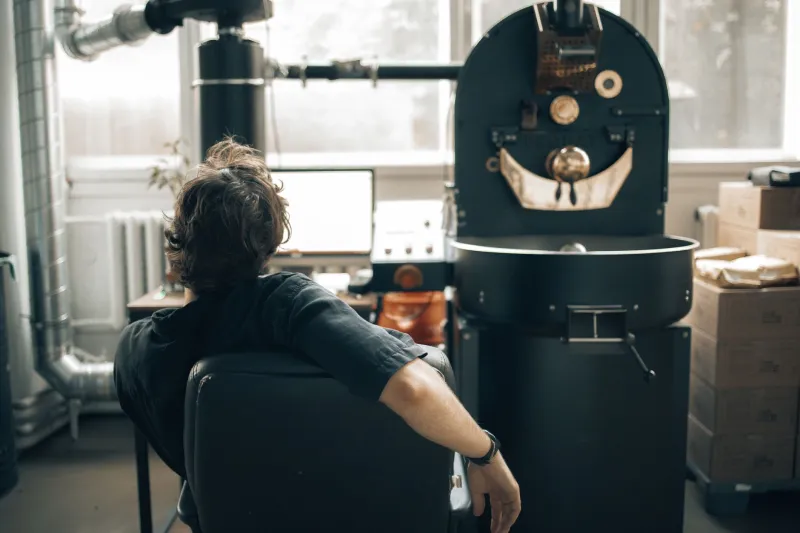
Small-batch roasters, working with drum capacities often measured in single-digit pounds, possess an intimacy with their craft that larger operations cannot replicate. They monitor the development time ratio — the proportion of total roast time spent after the beans reach what roasters call "first crack," the audible moment when internal steam pressure causes the cell walls to fracture. A longer development time encourages sweetness and body; a shorter one preserves volatile aromatic compounds that contribute to brightness and complexity. Adjusting these variables by increments of seconds and degrees Fahrenheit is the roaster's equivalent of the baker's crumb structure: invisible to the uninitiated, but immediately apparent to the educated palate.
Roasters such as Onyx Coffee Lab in Rogers, Arkansas, and Stumptown Coffee Roasters in Portland — both of which built their reputations on transparency and direct trade relationships — have demonstrated that this level of precision is not merely academic. When a roaster publishes the farm name, the harvest date, the processing method, and the roast date on every bag, they are extending an invitation to the consumer to engage with coffee as a living, seasonal ingredient rather than a static commodity.
Direct Trade and the Ethics of Sourcing
The vocabulary of specialty coffee sourcing deserves particular attention from the discerning home cook, because it bears directly on both flavor and the broader ethics of the pantry. "Fair Trade" certification, while meaningful in establishing minimum price floors, operates largely as a third-party auditing system that does not necessarily guarantee the quality relationships that the best roasters pursue.
Direct trade, by contrast, describes a sourcing practice in which the roaster maintains a personal relationship with the producer — visiting farms, negotiating prices above commodity market rates, and often collaborating on processing experiments that benefit both parties. Intelligentsia Coffee, founded in Chicago in 1995, is widely credited with formalizing this model in the American market. Their approach, since adopted and refined by roasters across the country, treats the green coffee purchase as a partnership rather than a transaction.
For the home cook building a considered pantry, understanding these distinctions matters. A bag labeled with a specific farm name, a harvest season, and a direct-trade notation is not marketing language; it is provenance documentation, and it carries implications for freshness and flavor that a generic "premium blend" cannot match.
Selecting and Storing Specialty Coffee as a Pantry Ingredient
The practical guidance for sourcing exceptional coffee begins with one principle that the specialty community has long emphasized: roast date matters more than expiration date. Coffee reaches its peak flavor expression between seven and twenty-one days after roasting, as carbon dioxide produced during the roasting process gradually dissipates and allows the bean's aromatic compounds to fully express themselves. A bag roasted six months prior and sitting on a grocery store shelf — regardless of its single-origin credentials — will not deliver the experience its provenance promises.
Subscription programs offered by roasters such as Counter Culture Coffee in Durham, North Carolina, or Bird Rock Coffee Roasters in San Diego, California, solve this problem elegantly by shipping freshly roasted coffee directly to the home on a regular schedule. Many roasters now allow subscribers to select their preferred roast level, processing style, and origin region, creating a sourcing experience that mirrors the intentionality of selecting wine from a trusted importer.
Storage is equally consequential. Whole beans retain their complexity far longer than pre-ground coffee; grinding immediately before brewing is not pedantry but practical preservation. An airtight container kept away from light, heat, and moisture will maintain quality admirably. Freezing whole beans in a sealed, portioned bag — removing only what will be used within a given week — is a practice endorsed by a number of professional roasters for long-term storage, provided the beans are allowed to return fully to room temperature before grinding.
Brewing as the Final Act of Craft
The roaster's work ultimately arrives in the home cook's hands, and the brewing method chosen will either honor or diminish everything that came before it. Pour-over methods — the Hario V60, the Chemex, the Kalita Wave — offer the clearest expression of a coffee's inherent characteristics, producing a clean, transparent cup that allows origin notes to speak without interference. Immersion methods such as the French press or AeroPress introduce more body and texture, which can complement naturally processed coffees with their inherently richer profiles.
Water quality deserves acknowledgment here. Specialty roasters consistently note that filtered water, free from the chlorine that municipal treatment introduces, will more faithfully extract the flavors they have worked to develop. A simple activated-carbon filter pitcher is sufficient for most home applications.
The morning cup, approached with this degree of intention, becomes something more than a caffeine delivery mechanism. It becomes a small, daily encounter with craft, geography, and the considered pleasures that a well-stocked pantry is designed to offer — a blessing, in the truest sense, that begins before the rest of the kitchen has even awakened.